
Every organization is being asked to do more with technology.
AI is entering workflows. SaaS applications are solving increasingly specialized problems. Cloud infrastructure is expanding. Automation is connecting processes that once operated independently. Cybersecurity platforms are becoming more sophisticated. Data is moving between more applications, users, vendors, and environments than ever before.
Individually, many of these decisions make perfect sense.
Collectively, they are creating something much harder to manage.
The business isn't simply buying technology anymore. It's accumulating an ecosystem.
And every addition to that ecosystem brings something with it: another owner, another contract, another integration, another set of credentials, another data flow, another dependency, another potential point of failure.
Eventually, technology capability begins expanding faster than the organization's ability to understand the environment it has created.
That's the technology gap.
More Capability. More Complexity.
Consider how easily the environment grows.
A business unit adopts an AI platform because it saves employees hours of work.
Another department purchases a SaaS application because the existing enterprise platform doesn't quite meet its needs.
IT moves another workload into the cloud.
Security adds another control.
A vendor connects its platform to the CRM.
Another application gets access to corporate identity.
An API begins moving customer information between two systems.
None of those decisions necessarily represents poor technology management.
The gap doesn't come from bad decisions. It comes from individually reasonable decisions accumulating faster than the organization can see and manage them as a whole.
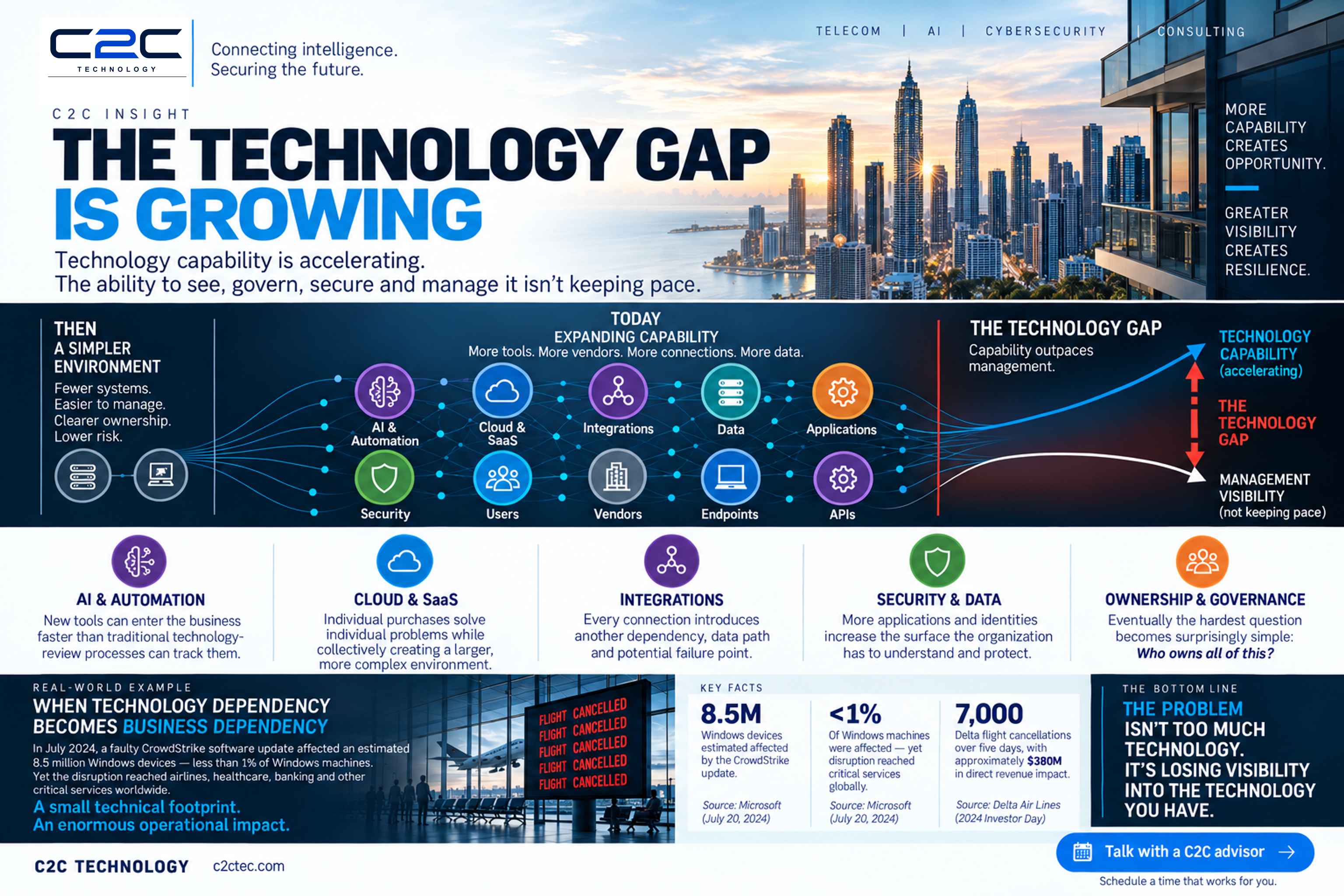
When Technology Dependency Becomes Business Dependency
In July 2024, a faulty CrowdStrike software update affected an estimated 8.5 million Windows devices — less than 1% of Windows machines worldwide, according to Microsoft. Yet the disruption reached enterprises operating critical services around the globe. Microsoft described the event as demonstrating the interconnected nature of today's technology ecosystem.
Delta Air Lines alone canceled roughly 7,000 flights over five days. Delta later reported approximately $380 million in direct revenue impact, primarily from refunds and customer compensation, along with another $170 million in non-fuel expenses.
A small technical footprint. An enormous operational impact.
That's what can happen when a single technology dependency sits underneath more of the business than the organization may fully appreciate.
The lesson isn't that CrowdStrike was a bad technology decision.
It's that a technology dependency can become a business dependency long before most of the business thinks about it that way.
And the same principle extends far beyond endpoint security.
If a cloud provider, identity platform, SaaS application, communications provider, API, AI service, or other critical vendor failed tomorrow, how quickly could the organization determine what else would be affected?
Visibility Is Becoming a Business Capability
As technology environments become more interconnected, knowing what an organization owns is no longer enough.
Leadership increasingly needs to understand:
- What is connected to what?
- What information moves between those systems?
- Who owns each relationship?
- Which business processes depend on them?
- What happens downstream when something fails?
That visibility affects more than IT.
It affects cybersecurity, business continuity, financial management, vendor strategy, customer experience, and the organization's ability to adopt new technology confidently.
The objective isn't to slow innovation.
It's to build the management capability necessary to support it.
Questions Worth Asking
- If one vendor had a bad day tomorrow, do you know which systems, teams, and customers would feel it?
- Who actually owns the full inventory of what's connected to what?
- When was “what do we have?” last answered with certainty instead of an estimate?
Those sound like simple questions.
For a growing number of organizations, they aren't.
The problem isn't too much technology.
It's losing visibility into the technology you have.
The organizations that solve that problem don't have to stop adopting technology.
They can adopt it with greater confidence because they understand the environment they're adding it to.
Need greater clarity around your technology environment?
Talk with a C2C Advisor