
Last week, we looked at the growing technology gap: the distance between what technology allows organizations to do and their ability to see, govern, secure, and manage it.
That raises an obvious question:
If the technology environment has become too complex, shouldn't we just simplify it?
Fewer applications. Fewer vendors. More standardization.
Sometimes that's exactly the right decision.
But there's another side to the argument.
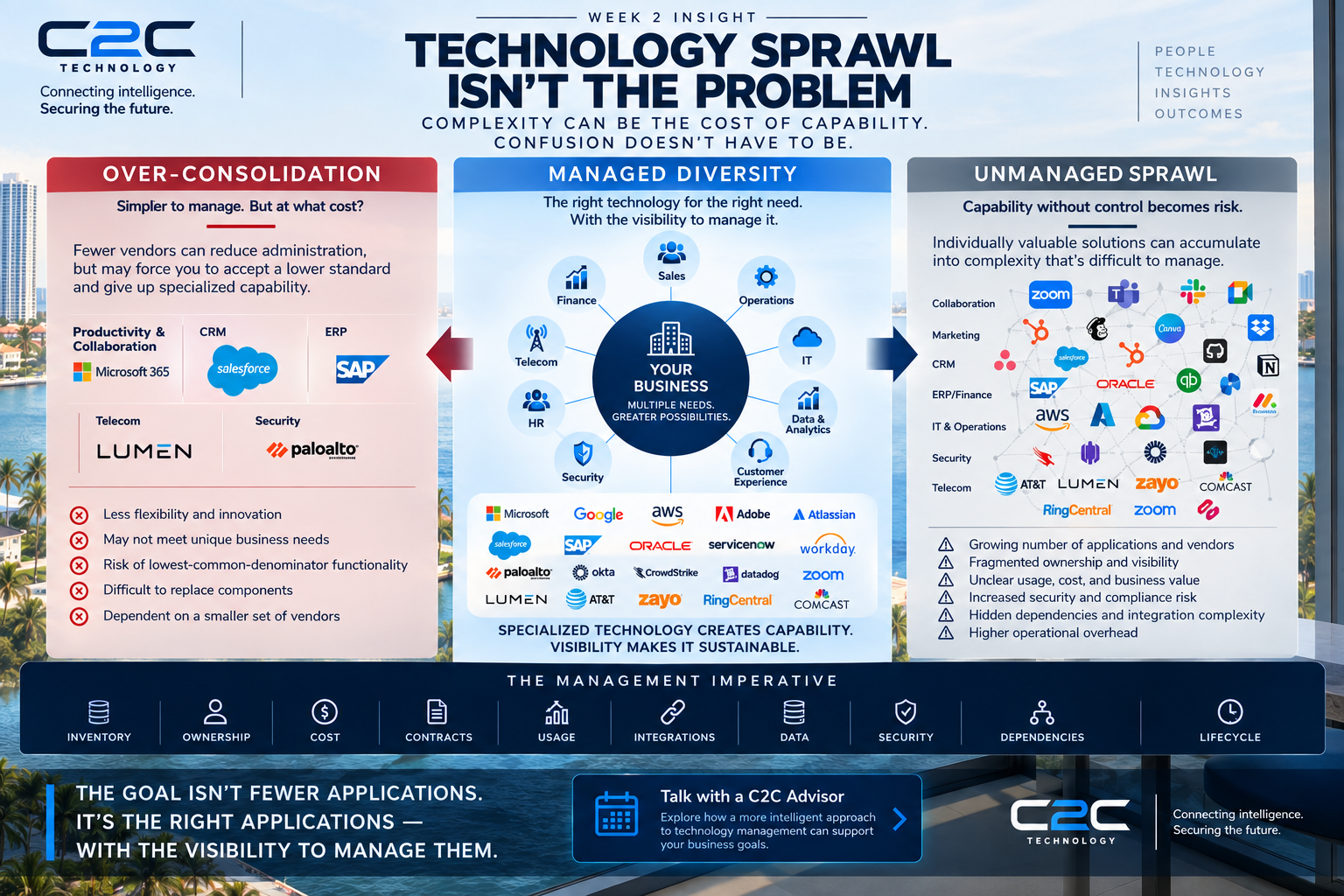
Organizations don't always accumulate technology because they've made poor decisions. They accumulate it because different parts of the business have different requirements—and specialized technologies exist to meet those requirements extremely well.
Sales has different needs than finance. Cybersecurity has different needs than marketing. Operations, HR, engineering, customer experience, data, and IT all have specialized requirements.
Technology diversity can be a source of capability, not evidence of failure.
THE SIMPLICITY TRADEOFF
Consolidation has obvious appeal.
Fewer vendors can mean simpler administration, fewer contracts, greater standardization, and potentially lower costs.
But consolidation isn't free.
McKinsey found that 77% of CIOs surveyed were concerned about having to standardize on a “lowest-common-denominator” solution—potentially accepting reduced functionality and poorer fit for the work in exchange for standardization. McKinsey also observed leading organizations using best-of-breed and vendor-agnostic approaches where appropriate.
Gartner describes the same tradeoff: best-of-breed products can provide superior functionality and flexibility, while suites can provide advantages such as unified data and simpler vendor management. The right choice depends on the business requirement—not simply the number of vendors.
A specialized application may exist precisely because it does something important better.
Replacing it with functionality inside a larger suite may simplify administration. But if the replacement doesn't meet the requirement as well, the organization has exchanged some degree of capability for simplicity.
Sometimes that's a good trade.
Sometimes it isn't.
WHEN COMPLEXITY BECOMES SPRAWL
The other side is just as important.
A diverse technology environment can deliver enormous capability.
An unmanaged diverse environment can become crippling.
IBM describes enterprise software sprawl as something organizations generally didn't deliberately create. It accumulated through reasonable decisions over time—new platforms, acquisitions, customized workflows, additional modules, and changing business requirements. The result can include recurring costs, redundancy, hidden dependencies, operational risk, and security exposure.
The problem isn't necessarily that another application was added.
The problem is reaching a point where nobody can confidently explain the environment anymore.
Why do we have it?
Who owns it?
Who uses it?
What does it cost?
What business requirement does it satisfy?
What is connected to it?
What depends on it?
And ultimately:
Does it still earn its place in the environment?
THE GOAL SHOULDN'T BE FEWER APPLICATIONS
Imagine two organizations.
One operates 75 applications but can't confidently identify their owners, usage, contracts, dependencies, or business purpose.
Another operates 300 and can.
Which one has the technology-sprawl problem?
Application count alone can't answer that question.
A healthy technology environment isn't defined by how few technologies it contains.
It's defined by whether the organization understands why those technologies exist and whether the value they create justifies the complexity they introduce.
That changes the objective.
Instead of asking:
How do we reduce the number of applications?
Start with:
How well do we understand the applications we have?
Then consolidation becomes one possible outcome of good technology management—not the strategy itself.
If two technologies are genuinely redundant, consolidation may make sense.
If a platform is underused, optimize or eliminate it.
But if a specialized technology provides capability the business genuinely needs, keeping it may be exactly the right decision.
The decision should follow understanding. Not the other way around.
WHY THIS MATTERS NOW
Technology environments aren't going to become less capable.
Specialized applications will continue appearing. Cloud services will evolve. Cybersecurity requirements will expand. AI will create new capabilities. Integrations will connect more of those systems.
Trying to solve that evolution simply by forcing everything into fewer platforms risks solving the wrong problem.
Allowing the environment to grow without sufficient visibility creates another.
The first step isn't deciding what to eliminate. It's knowing what you have well enough to make that decision intelligently.
QUESTIONS WORTH ASKING
- Do we know why every major technology in our environment exists?
- Can we distinguish true redundancy from technologies that satisfy different requirements?
- If we consolidated, what capability or flexibility would we actually give up?
- Do we understand ownership, utilization, cost, contracts, integrations, and dependencies well enough to know what should stay and what should go?
- Are we simplifying because it improves the business—or because the environment has become too difficult to manage?
THE BOTTOM LINE
Technology sprawl isn't simply a question of how much technology you have.
Modern businesses need specialized capabilities. Sometimes the technology that best meets one requirement won't come from the same vendor that best meets another.
Consolidation can create efficiencies.
It can also create compromises.
The goal shouldn't be to make the technology environment smaller. It should be to make it understandable.
Once an organization understands what it has, why it has it, what it costs, what it connects to, and what value it creates, it can make deliberate decisions about what should be consolidated, optimized, replaced—or deliberately retained.
Complexity can be the cost of capability.
Confusion doesn't have to be.
Is your technology environment becoming harder to understand than it should be?
Talk with a C2C Advisor