
Last week, we argued that the goal shouldn't be fewer applications.
Modern businesses need specialized technologies because different parts of the organization have different requirements. The right answer isn't automatically consolidation. It's understanding the environment well enough to know what should stay, what should change, and why.
That leads to the next question:
Where does that understanding actually live?
In most organizations, the answer isn't one place.
IT knows part of it. Finance knows part of it. Procurement knows part of it. Security knows part of it. Business units know why particular technologies matter. Vendors know the services they're providing.
Everyone owns a piece.
But who owns the picture?
THE INFORMATION IS EVERYWHERE
Think about what it takes to fully understand a single technology.
IT may know how it's configured.
Finance knows what gets paid.
Procurement has the agreement and renewal terms.
Security understands the risk.
The business unit knows why the technology exists and whether people actually use it.
The vendor knows the service details, order history, and product roadmap.
None of those perspectives is wrong.
They're simply incomplete on their own.
And the challenge is getting harder.
Flexera's 2026 State of ITAM research found that only 36% of organizations reported complete visibility across their IT estate. Visibility varies considerably by technology category: 66% reported visibility into SaaS, while only 31% reported visibility into AI software.
As the technology environment expands, organizations are being asked to manage technologies that don't necessarily enter the business through the same people, processes, or systems.
The problem isn't necessarily missing information.
Often, the information exists. It's just distributed across the organization.
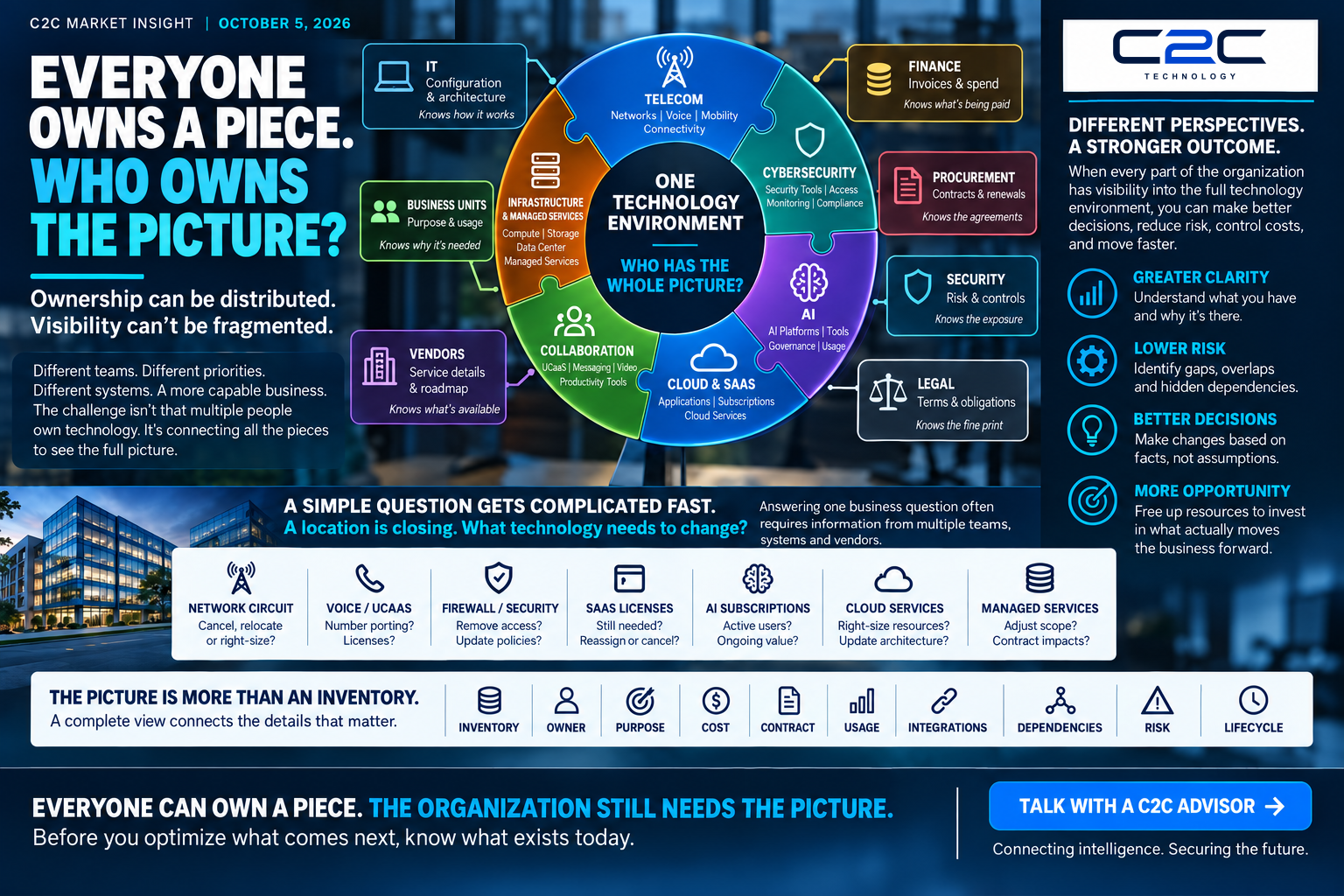
A SIMPLE QUESTION GETS COMPLICATED FAST
Imagine one of your locations is closing.
The question sounds simple:
What technology needs to change?
Start with the network.
Is there a dedicated circuit at the location? Who is the carrier? When does the contract expire? Is there an early termination liability? Is that circuit supporting anything outside the building?
What about voice?
Are numbers assigned to the site? Are there contact-center dependencies? Teams, Zoom, SIP, UCaaS, or emergency-service requirements?
Then security.
Are firewall, endpoint, identity, SASE, or other security licenses tied to the users or location?
Then software.
Which SaaS subscriptions are assigned to the employees there? Are any contracts location-specific? Are there licenses that should be reclaimed?
What about cloud services, AI subscriptions, devices, managed services, or vendor agreements?
Finance may see the charges.
IT may see the infrastructure.
Security may understand the controls.
Operations knows what is actually happening at the location.
Procurement may hold the contracts.
But answering one business question requires connecting all of those pieces.
That's where fragmented visibility becomes expensive.
DISTRIBUTED OWNERSHIP ISN'T THE PROBLEM
The answer isn't to force every technology decision into one department.
That would create a different problem.
The people closest to a business requirement often should have a meaningful role in selecting and managing the technology that supports it.
Security should understand security requirements.
Finance should understand financial requirements.
Operations should understand operational needs.
Business teams should understand the capabilities they depend on.
IT should understand architecture, integration, and support.
The FinOps Foundation defines technology-value management as a collaborative practice across engineering, finance, and business teams. Its current framework extends beyond public cloud into technology categories including SaaS, licensing, AI, private cloud, and data centers.
So distributed responsibility is not inherently a weakness.
The weakness appears when distributed responsibility produces fragmented organizational knowledge.
Ownership can remain distributed.
The picture still needs to come together.
THE PICTURE IS MORE THAN AN INVENTORY
Knowing that an application, circuit, security platform, or cloud service exists is useful.
But existence alone doesn't tell you very much.
A useful technology picture connects:
What is it?
Where is it?
Why do we have it?
Who owns it?
Who uses it?
What does it cost?
What contract governs it?
When does that contract change or renew?
What is it connected to?
What depends on it?
Where is it in its lifecycle?
That is why a spreadsheet containing vendor names and monthly charges isn't the same thing as understanding the environment.
Deloitte describes IT asset management in similar terms: integrating technology assets across business units and combining financial, inventory, contractual, and risk-management information across the entire lifecycle to support tactical and strategic decisions.
The important word there is integrating.
The individual pieces don't create much intelligence until they can be connected.
WHY THIS MATTERS NOW
Technology decisions increasingly happen across the organization.
SaaS can be purchased by a department.
AI tools can enter through individual teams.
Cybersecurity involves specialized platforms and vendors.
Cloud resources can change continuously.
Telecom services can span hundreds of locations, contracts, carriers, and renewal dates.
And vendors themselves change.
Last week's unscheduled C2C Market Insight on Lumen was a timely example.
When a provider changes its portfolio direction, the important question isn't simply:
What did the vendor announce?
It's:
What in our environment does this affect?
Which locations?
Which contracts?
Which services?
Which dependencies?
Which upcoming projects?
Which decisions now need to be revisited?
If answering those questions requires rebuilding the environment from invoices, spreadsheets, portals, contracts, emails, and people's memories every time something changes, the organization doesn't just have an information problem.
It has a baseline problem.
QUESTIONS WORTH ASKING
- If someone asked for a complete picture of our technology environment today, how many people and systems would we need to consult?
- Can we connect what we're paying for with who owns it, who uses it, and why it exists?
- Do we know which technologies are tied to specific locations, contracts, vendors, or business processes?
- If a vendor changed direction tomorrow, could we quickly identify everything affected?
- Are we managing from a reliable baseline—or reconstructing the environment every time we need to make a decision?
THE BOTTOM LINE
Technology ownership doesn't need to live in one place.
In a modern organization, it probably shouldn't.
But the organization still needs one reliable understanding of the environment those decisions collectively create.
Before you can optimize, consolidate, renew, replace, modernize, or confidently adopt something new, you need to understand what already exists.
What it is.
Why it's there.
Who owns it.
What it costs.
What governs it.
What it connects to.
And what happens next.
Everyone can own a piece.
The organization still needs the picture.
Ownership can be distributed.
Visibility can't be fragmented.
How difficult would it be to produce a complete, current picture of your technology environment today?
Talk with a C2C Advisor