
Last week, we asked who owns the picture.
IT, finance, procurement, security, the business units, and the vendors each hold part of it. Ownership can stay distributed. The picture still has to come together.
But once an organization agrees it needs that picture, a harder question follows:
What exactly belongs in it?
A list of vendors isn't enough. A stack of invoices isn't enough. A spreadsheet of applications isn't enough.
Knowing what you have means understanding the business relationship around each technology, not just its name.
AN INVENTORY ISN'T A BASELINE
Most organizations can produce something like this:
Lumen — Internet
Microsoft — 365
CrowdStrike — Security
Zoom — Communications
That's useful. It tells you what exists.
It doesn't tell you enough to make a decision.
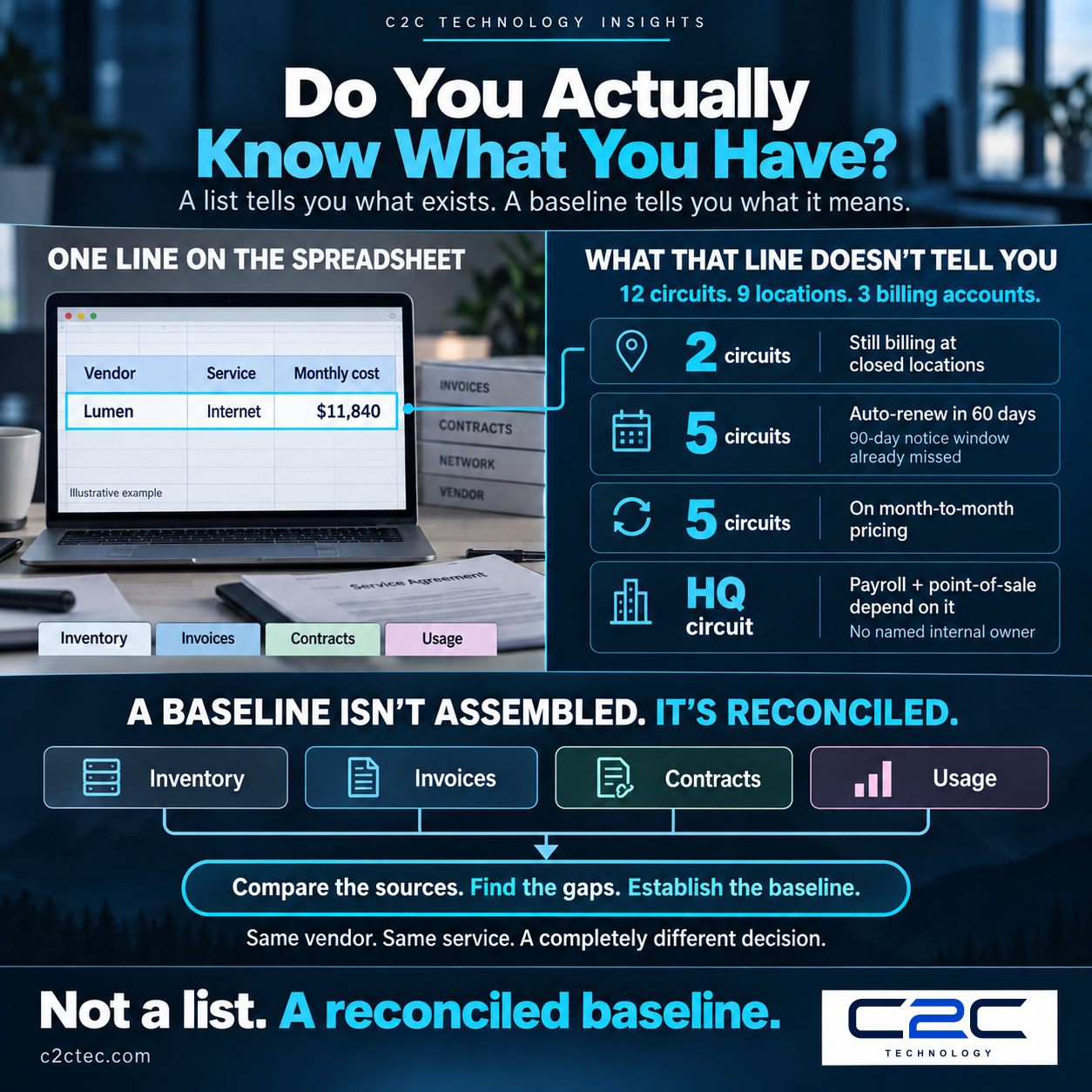
ONE LINE, OPENED UP
Take the first line. (This is an illustrative example.)
On the spreadsheet, it reads: Lumen — Internet — $11,840 a month.
Opened up, that single line turns out to be 12 circuits across 9 locations, billed on 3 separate accounts.
Two of those circuits are still billing at locations that closed last year.
Five are on a term that auto-renews in 60 days, and the 90-day notice window has already passed.
Five others have outlived their original term and rolled to month-to-month pricing.
And the headquarters circuit that payroll and point-of-sale depend on has no named internal owner.
Same vendor. Same service. Same line on the spreadsheet.
A completely different decision.
That's the difference between an inventory and a baseline. The inventory names the technology. The baseline connects it to where it is, who owns it, what it costs, what governs it, when it changes, and what depends on it.
Technology decisions aren't made from names on a spreadsheet.
They're made from context.
THE SAME GAP SHOWS UP EVERYWHERE
Telecom is simply the easiest place to see it.
In SaaS, the gap shows up in licenses. Zylo's 2026 SaaS Management Index puts the average organization at 305 applications, and finds that only 54% of provisioned licenses are actually being used. The invoice shows every seat. Usage tells a different story.
In cybersecurity, an organization may know which platforms it owns, but not where their capabilities overlap, which systems each one actually protects, or when each agreement renews.
In AI, it may know employees are using AI tools, but not which enterprise subscriptions exist, who approved them, or what data obligations came with them.
The pattern is the same in every category. Finance sees the charge. The business unit knows the purpose. IT knows the integration. Procurement knows the contract.
The baseline only exists when those facts are connected.
THE REAL TEST IS CHANGE
Incomplete visibility rarely hurts on an ordinary Tuesday. It hurts when something changes.
A renewal arrives. A location closes. A company is acquired. A vendor changes direction. A new AI platform is proposed.
Leadership needs an answer, and that's when the gaps surface. In the same Zylo research, 78% of IT leaders reported unexpected AI or consumption-based charges in the past year.
If the baseline already exists, the organization makes the decision.
If it doesn't, everyone starts reconstructing reality: invoices, portals, contracts, spreadsheets, emails, vendor calls, and people's memories.
A baseline shouldn't be something you rebuild every time you need to make a decision.
A BASELINE ISN'T ASSEMBLED. IT'S RECONCILED.
This is where most attempts to build one go wrong.
The natural approach is to ask everyone for their piece and combine the answers. That produces a longer list. It doesn't produce a baseline.
Each source is answering a different question.
The inventory says what we think we have. The invoices say what we're paying for. The contracts say what we agreed to. Usage says what the business actually relies on.
In a well-managed environment, those four versions agree.
In most environments, they don't. And the places where they disagree are exactly where the cost and the risk are hiding.
The circuit at the closed location is on the invoice, but not in the inventory. The auto-renewal is in the contract, but not on anyone's calendar. The unused licenses are on the invoice, but not in usage.
None of those show up by asking people what they own. They show up when the sources are compared against each other.
That's why the contract matters as much as the charge. Across contracts of every kind, World Commerce & Contracting puts the average gap between what agreements were expected to deliver and what they actually delivered at 8.6%. In technology, that gap tends to sit in the places nobody reconciles: notice windows, out-of-term pricing, and services that outlived their purpose.
BEFORE YOU OPTIMIZE ANYTHING, YOU NEED THE BASELINE
Cost reduction. Vendor consolidation. Renegotiation. Modernization. Better security. AI adoption.
Every one of those starts from the same question: what are we starting with?
Without a baseline, optimization becomes guesswork.
You may eliminate something that looks redundant but serves a different requirement. You may renew something nobody uses because nobody knew the renewal was coming. You may replace a platform without understanding what depends on it.
As we said two weeks ago: the decision should follow understanding. Not the other way around.
QUESTIONS WORTH ASKING
- If leadership asked for a complete list of our technology vendors today, could we produce it confidently, and would it match what we're paying for?
- When did anyone last compare our invoices against our inventory, line by line?
- Which contracts renew in the next 12 months, and which have notice windows that close before then?
- How many of the licenses we pay for has anyone used in the last 90 days?
- Can we connect every major technology expense to an owner and a business purpose?
- Are we operating from a current baseline, or reconstructing one whenever something changes?
THE BOTTOM LINE
Technology management starts before optimization. Before consolidation, renegotiation, or modernization. Before deciding what should stay or go.
It starts with knowing what you actually have.
Not a list. A reconciled baseline, where what you think you have, what you pay for, what you agreed to, and what you actually use finally tell the same story.
You can't manage what you haven't established.
How confident are you that your technology baseline is complete today?
Need greater clarity around your technology environment?
Talk with a C2C Advisor